
Sudans ElObeid Under Drone Pressure Fears El Fasher Fate
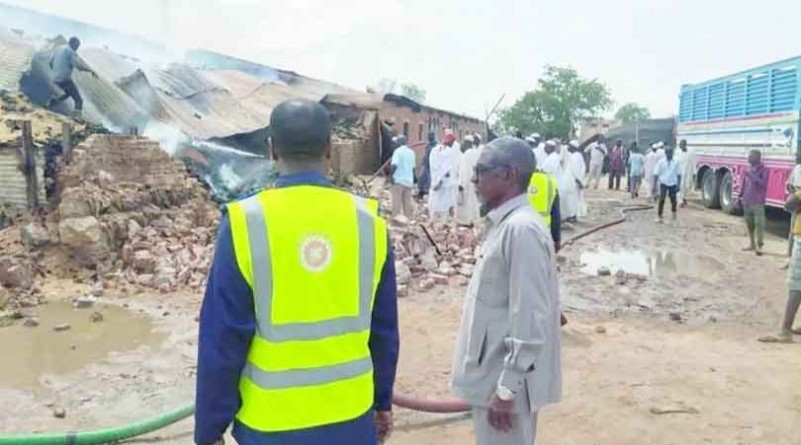
Only hours after the United Nations and several Western countries urged the Rapid Support Forces to halt its assault on el-Obeid, the capital of North Kordofan state, it was plunged into darkness.
A drone strike hit the city’s main power station, marking the latest in a wave of attacks that have battered el-Obeid for days.
Local sources said a strategic drone belonging to the RSF struck the electricity substation late on Thursday, cutting power across the city. By Friday morning, strikes had resumed on other sites inside al-Obeid.
For residents of the city, known in Sudan as the “Bride of the Sands,” the blackout was not an isolated blow. It was another episode in a weeks-long buildup of pressure. In recent days, heavy drone attacks have killed more than 40 civilians and wounded dozens, according to local sources.
The strikes have also hit fuel stations, supply trucks and civilian and military sites, spreading fear through the city.
Local witnesses said drones still fly regularly over el-Obeid, turning anticipation into part of daily life.
Residents said they now track the movement and sound of drones more closely than they follow the news on television or smartphones.
Some have cut back their movements or stayed indoors, fearing sudden attacks after repeated strikes on civilian and service facilities in recent days.
Fears of an El Fasher scenario
Those fears have deepened because of what happened in El Fasher, the capital of North Darfur state, which fell to the RSF last year after months of siege and military attrition.
Since then, El Fasher has become the reference point in every discussion about the fate of el-Obeid, especially as attacks intensify and pressure on the city grows.
El-Obeid lies about 411 km from Khartoum and forms the main link between Darfur and central Sudan. It is also home to the headquarters of the 5th Infantry Division, known as the Haggana, a name derived from the use of camels in military operations.
The division is one of the Sudanese army’s most important units.
But el-Obeid’s importance is not only military. It is also economic, political and logistical. The city lies near the center of Sudan, at the meeting point of Darfur, Kordofan and the country’s central regions. For decades, that position has made it a major hub for trade, transport and the movement of goods.
El-Obeid is connected to roads, railway lines and vital supply routes linking western Sudan to the east, making it an important center for trade, supplies and transport.
It is also a major administrative and political center in Kordofan, with a historical symbolism that has made it one of the most influential cities in western Sudan.
That importance helps explain why el-Obeid has become a key target in the battles between the army and the RSF. For the army, the city is a major base for current or future military operations in Kordofan and Darfur. It is also the most important line of defense for central Sudan.
‘El-Obeid will not fall’
Former Sudanese army chief of staff General Hashem Abdel Muttalib told Asharq Al-Awsat that the RSF is using its attacks to disrupt the army and prevent it from advancing towards Darfur. But he ruled out the possibility that drones could achieve that goal.
“El-Obeid will not fall,” he said.
The army goes further in dismissing any direct threat to the city. Colonel al-Basha Hakim, commander of the armored corps in the 5th Infantry Division, the Haggana, told Asharq Al-Awsat that the Rapid Support Forces are far from the outskirts of al-Obeid and that talk of a siege is only a rumor.
He said military plans are moving as intended and that the attacking forces have suffered heavy losses. He added that the army, joint forces and supporting forces are working in full coordination, and that residents will soon hear “good news.”
But the reassurances have not erased the fears. Military expert Saleh Abdullah told Asharq Al-Awsat that what is happening in el-Obeid resembles tactics used by the RSF in El Fasher: sustained pressure, attrition, weakening services and opening routes for those who want to leave the city.
The targeting of infrastructure has sharpened those concerns. Fuel stations have repeatedly come under attack, and fuel trucks on roads leading to the city have also been hit. The result has been a severe transport crisis in recent days, directly affecting residents’ movement and public services.
Residents said fuel has become part of the battle around el-Obeid. Repeated attacks on supplies have disrupted transport and pushed up the cost of moving around the city.
Still, the picture inside al-Obeid is not entirely bleak. Journalist Zuhair Hashem, who lives in the city, told Asharq Al-Awsat that life continues normally in most neighborhoods.
He said the recent transport crisis was linked mainly to the targeting of five fuel stations in one day, which knocked some of them out of service, rather than to a wider collapse of services or daily life.
Political analyst Osman Mirghani told Asharq Al-Awsat that el-Obeid’s military position makes capturing it harder than many assume.
He said the presence of the 5th Infantry Division, with its equipment and forces, gives the city a strong defensive capacity. He ruled out its fall, or even the approach of such a threat, for now.
According to Mirghani, the Rapid Support Forces understand el-Obeid’s importance as the army’s strongest defensive line west of Omdurman. That is why, he said, they are using drones to put psychological pressure on residents and push some of them to flee, rather than trying at this stage to settle the battle militarily.
Even so, concern is no longer confined to the city. The latest developments have prompted the United Nations and several Western countries to warn against military escalation around el-Obeid and call for an end to the attack, in a sign of growing fears that the humanitarian situation could deteriorate if operations continue at the current pace.
Between the army’s reassurances, international warnings and the fears of residents living under the sound of drones and disrupted services, el-Obeid has become one of Sudan’s most sensitive cities at this stage of the war.
If El Fasher has become the example everyone invokes when speaking of siege and collapse, the question now confronting the “Bride of the Sands” is whether it can avoid the same fate, or whether the war is gradually pushing it towards that scenario, even if the tools and circumstances differ.
aawsat.com