
Assassination of AlArabiya journalist highlights tensions in southern Yemen
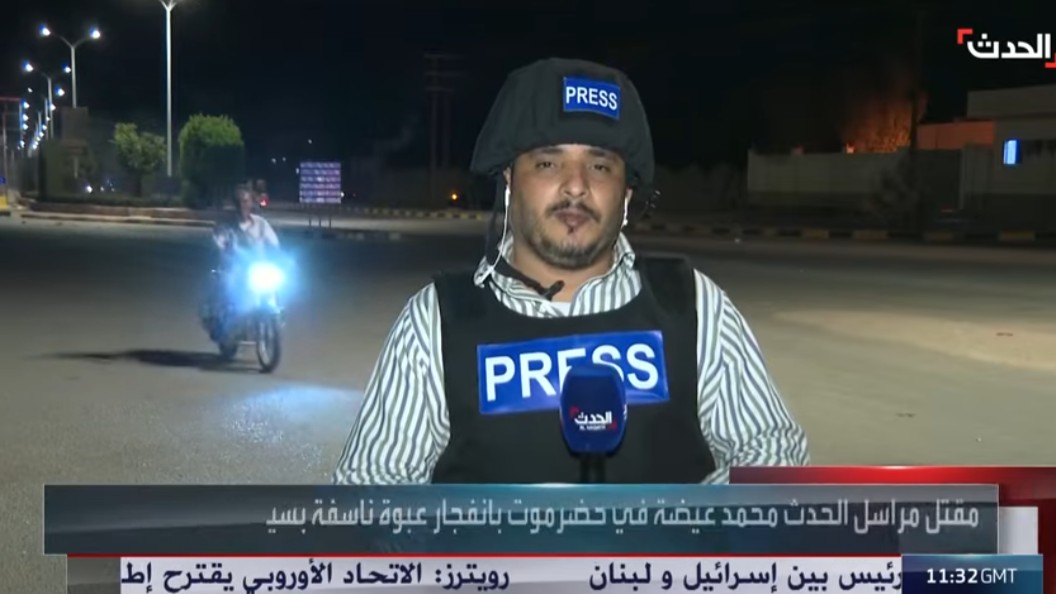
On the evening of 24 June, Al Arabiya and Al Hadath correspondent Mohammed Aydah started his car outside his family's home in Mukalla, the capital of Yemen's eastern Hadramaut governorate, when an IED planted under his driver's seat detonated.
He had just dropped his family off at home and was on his way to meet a friend. The blast set his vehicle ablaze on Sitteen Street, near the Pakistani School in central Mukalla.
The 40-year-old was killed instantly.
Local security authorities had warned Aydah roughly a month earlier that his life was under threat, urging him to take those warnings seriously.
He had been working as a freelance photographer and correspondent for Saudi state-owned Al Arabiya since 2019, covering political, security and development stories across eastern Yemen.
New MEE newsletter: Jerusalem Dispatch
Sign up to get the latest insights and analysis on Israel-Palestine, alongside Turkey Unpacked and other MEE newsletters
His reporting on demonstrations by the UAE-backed Southern Transitional Council (STC) and his documentation of that authority's conduct had made him enemies.
At the time of writing, no group from Yemen's fragmented political landscape has claimed responsibility.
The Presidential Leadership Council (PLC), backed by Saudi Arabia and based in Aden, condemned the attack. Salem Ahmed Al-Khanbashi, the governor of Hadramaut and the general who led the military recapture of the region from the STC in early January, ordered an investigation. Prime Minister Shaya Mohsen al-Zindani directed the Interior Ministry and security agencies to identify those responsible.
'We are a project of peace, not death. If we were going to create chaos, we would target Saudi-backed officials, not a journalist'
- STC National Assembly member
A spokesperson for the now fractuous and disputedly dissolved STC was quick to blame Al-Qaeda in the Arabian Peninsula (AQAP) and other armed groups.
The accusation was widely questioned. Issuing prior threats is not consistent with AQAP's modus operandi, which tends toward sudden, unclaimed violence rather than forewarned targeting of specific individuals.
The statement was also read as political opportunism: by attributing the killing to "terrorist" groups, the STC implicitly argued that such groups had been kept in check during its own rule.
A member of the STC's National Assembly, who did not wish to be named, pushed back against accusations of involvement.
"It is true that we consider Saudi Arabia a major enemy, as it has been damaging the south, but that doesn't mean we will assassinate or welcome the assassination of a civilian journalist," he told MEE.
"We are a project of peace, not death. If we were going to create chaos, we would target Saudi-backed officials, not a journalist."
He argued instead that the Saudi-backed governor and the Aden government had "failed to maintain security", noting that "in just six months, we have heard of several assassinations in the south: terrorists didn’t dare to create chaos during the STC’s regime, but today they move freely in the south and try to create chaos here and there.”
The Houthis, who control Sanaa and have fought the Saudi-led coalition for over a decade, condemned the assassination through their Al Masirah channel without assigning blame, while using the incident to highlight instability in government-held areas.
Ibrahmi Jalal, a senior Yemen and Gulf analyst, told MEE both the STC and Houthis had reasons to resent Aydah's coverage.
“When we look at the landscape and examine who might have access to sleeping cells and sabotage activities with the intent to disrupt and undermine the stability of government-held areas, there are two primary actors: the Houthis and the quote-unquote self-dissolved STC," he said.
Repeated assassinations
The killing of Mohammed Aydah is not an isolated event. Since the STC's military defeat and its highly contested dissolution between late December 2025 and January 2026, targeted political assassinations in southern Yemen have risen markedly.
In May, Wesam Qaid, CEO of the Social Fund for Development, was abducted and killed in Aden.
In April, Abdulrahman Al Shaer, an educator and senior Islah party member, was assassinated. In January, an attempted assassination targeted Salafi brigadier general Hamdi Shukri, now commanding a vast military region in the south.
Baraa Shiban, a senior Yemeni political analyst, noted that in the Al Shaer case arrests were made of a cell linked to the former counterterrorism units: one of the main units that operated under the umbrella of the STC.
'Whoever targeted Mohammed wanted to silence him, but it was also a threat to all other journalists'
- Baraa Shiban, senior Yemeni political analyst
"The prosecution has started the process of making charges, but it will take time," he said.
Previous investigations by the BBC have established direct links between the UAE-backed group and a series of earlier assassinations in Aden.
Commentators have drawn a possible inference: that killings were relatively rare during the period of STC administrative control, and that their recent proliferation may indicate that STC-affiliated networks are now directing or enabling them, outing itself as a militia that no longer holds territory but retains armed influence.
As one source familiar with the political atmosphere in Aden put it: "The night Saudi Arabia lost the World Cup game against Spain, STC members were launching fireworks across southern governorates.
"When Aydah's assassination took place, they condemned it publicly but rejoiced privately, given his critical coverage of STC demonstrations."
The STC's dissolution did not mean its disappearance. Its security and military formations were not fully dismantled: some units were redeployed, others nominally absorbed into the IRG's structures.
Jalal explained: "Some security forces have been integrated into local and national arrangements, but they still retain STC-loyal personnel. They haven't changed their opinions, haven't changed their intent.
"It remains to be seen how well they would be absorbed and demonstrate a sense of belonging to an institution that protects the people above all."
The STC's exiled leader, Aidarous al-Zubaidi, fled to Abu Dhabi in January, from where he continues to issue statements. The UAE, analysts suggest, does not regard its setback as permanent.
Saudi investment
This assassination lands at a peculiarly uncomfortable moment for Saudi Arabia's approach to Yemen. Just two weeks before Aydah was killed, Riyadh signed a $150m agreement to supply petroleum derivatives to power plants across Yemen - the latest installment of more than $12.6bn in Saudi support since 2012.
A ceremony had taken place in Mukalla itself for a 100 MW power plant developed through a tripartite deal between the Saudi Development and Reconstruction Programme for Yemen, Yemen's Ministry of Electricity, and Gulf Power International.
Yemen’s president Rashad al-Alimi has publicly cast Saudi economic assistance as the essential glue holding Yemen's government institutions together, asking Yemenis to exercise "more patience" to see its full effects.
For Yemenis on the ground, accessing basic services like electricity and water is the top priority, and they support whichever side provides them with these necessities.
Murad Ali, a building labourer in his 60s from Aden, focuses entirely on providing his seven family members with food and other basic needs, while still hoping the government can help them access electricity, water and healthcare services.
“Our government failed to provide us with electricity, healthcare, or any other basics, and it is Saudi Arabia that has been helping us since January 2026 to access basic services,” he told MEE.
But patience on the ground is being tested. In early June, as temperatures skyrocketed and the electricity supply continued to fail, hundreds of civilians in Aden took to the streets, or rather their mattresses, sleeping outside in protest at power cuts.
Local sources described the demonstrations as apolitical and driven by anger at failing infrastructure, not about the PLC's administration and that STC organisers attempted to co-opt the protests and largely failed.
"When we took to the streets, we were calling on Saudi Arabia to help us because we know it is the only country that can. We cursed our government because it deserves it, but we didn’t call on them because we know they are unable to help," said Ali.
Jalal argued that the gap between reconstruction rhetoric and security reality is a vulnerability: "When we look at the profiles of those targeted - a journalist, a religious figure, teachers, a social development champion, military commanders - the picture indicates that most societal figures, regardless of their walk of life, are under a sustained elimination attempt.
"[The motive is] to instil fear, demonstrate instability, question trust in the government and its backer Saudi Arabia, and shake the image that is now enabling the government to seek increased support from international development institutions like the World Bank and the IMF."
Stabilisation and security
Underlying all of this is an unfinished political process: following the military recapture of southern territory, PLC President Rashad al Alimi called for a comprehensive Southern Dialogue Conference to be hosted by Saudi Arabia for which no date has been set.
In February, STC-affiliated demonstrators in Ataq stormed a government building; security forces killed five people and wounded 39.
Saudi Arabia's bet is that infrastructure funding, a credible southern political process, and the unification of military command under the PLC can consolidate its position before the northern Houthi front demands attention again.
Jalal added that stabilisation required a multi-dimensional approach.
"Economically, the government needs more than emergency funding: it needs to improve domestic revenue collection and resume oil and gas exports, hampered since 2015 and 2022 respectively," he said.
"On security, undoing a decade of fragmentation requires time, but also a more adaptive and proactive approach. The full cabinet leadership needs to return to the country, to be with the people, rebuild institutional trust, and pave the way for recovery."
The assassination of Mohammed Aydah, whether or not it is ultimately linked to STC remnants, shows how much remains unsettled in the territory Saudi Arabia now formally controls.
"Whoever targeted Mohammed wanted to silence him, but it was also a threat to all other journalists. At the end of the day, they won't be able to silence everyone if everyone is speaking up and everyone is active," said Shiban.
middleeasteye.net