
His death has killed a part of me: The Ethiopians awaiting execution in Saudi Arabia
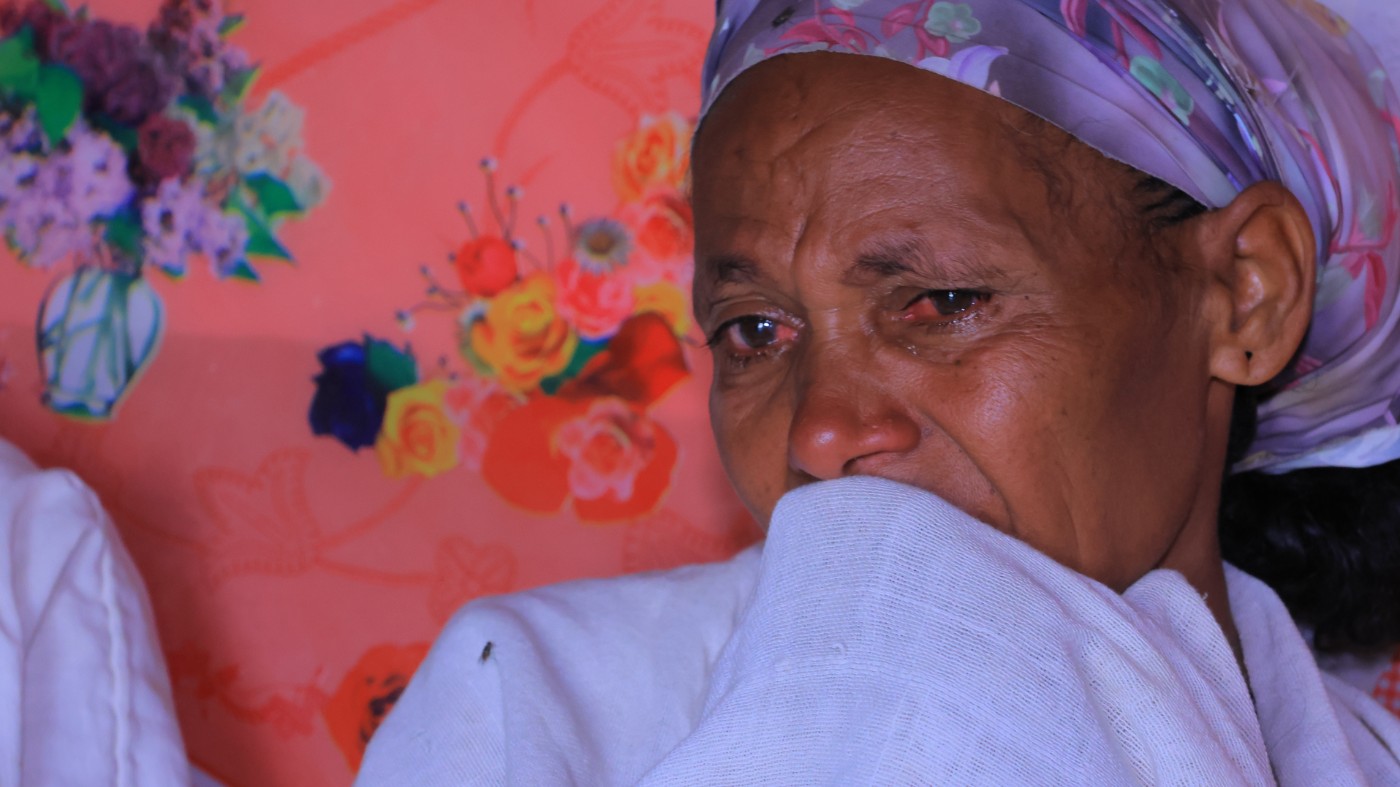
In Saudi Arabia’s Khamis Mushait detention facility, hundreds of Ethiopian prisoners are held on death row in harrowing conditions, waiting in fear of their eventual execution.
On 21 April, the shouts of the guards echoed through the overcrowded prison in Aseer province as they came to read out the names of those scheduled to be executed.
Three Ethiopians were taken away to their fate.
Hailay Berhane, a migrant from the Gulomahda district of northern Ethiopia’s Tigray region, is being held in Khamis Mushait. He told Middle East Eye what happened using the messaging app Imo. Like other prisoners MEE communicated with for this article, his name has been changed.
“Guards came early in the morning in a rush, handed cards to three of the Ethiopian migrants among us and took them away,” he said.
New MEE newsletter: Jerusalem Dispatch
Sign up to get the latest insights and analysis on Israel-Palestine, alongside Turkey Unpacked and other MEE newsletters
“Two hours later, the same guards came back and told us that the three migrants had been beheaded and warned us that is what awaited us all.”
Ephrem Kidane, another death row prisoner, also saw his friends taken away. After they were executed, he told MEE, the guards wrapped their lifeless bodies in their blankets.
Kibrom Gebremariam, Tsigabu Hagos and Kidane Angesom were executed. They were young men who had fled to Saudi Arabia from war-ravaged Tigray, where the humanitarian situation remains dire.
The three Tigrayans had crossed the Gulf of Aden and travelled through Yemen to Saudi Arabia, seeking work. They carried khat, the plant chewed as a mild stimulant in large parts of east Africa, with them.
The young men did not know that, while legal in Ethiopia and Yemen, carrying khat is illegal in Saudi Arabia.
Drug charges in Saudi Arabia
According to Human Rights Watch, Saudi security authorities arrested the three Ethiopians between 2023 and 2024, accused them of drug-related offences, and moved them between various detention centres until they ended up in Khamis Mushait.
On 23 June, five more Ethiopian nationals were executed, among many foreigners accused of non-violent drug crimes by Saudi authorities. Multiple sources said the prisoners admitted to the crimes, fearing that if they did not, they would simply be executed without legal assistance.
'They handed me 41kg of drugs and forced me to believe it was mine, and made me sign documents that I don’t even understand'
- Hailay Berhane, Ethiopian prisoner in Saudi Arabia
The migrants were forced to sign documents in Arabic without understanding their content and, in some cases, were beaten by security forces, said Berhane.
“They handed me 41kg of drugs and forced me to believe it was mine and made me sign documents that I don’t even understand what they were saying in Arabic,” he told MEE, recalling the moment he was caught by Saudi security men three years ago.
He was in the deadly border region between Yemen and Saudi Arabia known as Rago. It’s a place that has become known for the brutal apprehension of migrants, with human rights organisations highlighting accusations that Saudi border guards have fired indiscriminately on them.
“In the past three years, I appeared in court three times for a very short period, all without an interpreter,” Berhane said, describing how difficult it was to present his case and prove his innocence.
“Foreign nationals who are on death row in Saudi Arabia are, most of the time, subjected to grossly unfair trials,” said Yared Hailemariam, an Ethiopian human rights advocate.
Almost 100 executions in Saudi Arabia this year
Saudi authorities have executed almost 100 people so far this year, including at least 61 for drug-related offences, according to a new report from Amnesty International.
“Foreign nationals have borne the brunt of Saudi Arabia’s ruthless use of the death penalty for drug-related offences, frequently after grossly unfair trials,” the report said.
'Every time the security guards knock on the door, we feel that our names will be called'
- Kidane, Ethiopian prisoner in Saudi Arabia
Amnesty said that it was “profoundly alarming” that at least 63 Ethiopian nationals are being held in a single ward of Khamis Mushait, and that they were at “imminent risk of execution solely for drug-related offences”.
According to local officials, local civil society organisations and human rights defenders who spoke with MEE, as many as 200 Ethiopian citizens are currently on death row awaiting execution in Saudi Arabia. Many prisoners say the figures could be higher.
“There are many migrants in all six prison blocks here in Saudi Arabia,” Berhane said. “In the Khamis Mushait detention facility there are 58 Ethiopian migrants, and most are from Tigray, uprooted by constant conflict and crises, and dwindling humanitarian support.”
Speaking on a phone smuggled into the detention centre, with security cameras following his every move, the Ethiopian prisoner said he wonders how long he has left to live.
“Every time the security guards knock on the door, we feel that our names will be called and we will become another figure among many who are wrongly accused like myself, whose plea goes on unnoticed,” Kidane, another prisoner, told MEE.
Kibrom Gebremariam, 30, was among the Ethiopian migrants executed at Khamis Mushait detention facility for drug-related offences on 21 April.
News of Kibrom’s death shocked his parents in the Egela district of Tigray, from where many young people migrate to Saudi Arabia.
Of the family’s seven children, two had already made the hazardous journey across the Gulf of Aden and then through war-torn Yemen.
'We anticipated Kibrom’s wedding, not his death. His murder has become an open wound for us'
- Gimja Gebremariam, mother
Kibrom's older brother, Merhawi, who migrated illegally to Yemen in 2020, was killed by security forces three years ago. Migration has now claimed two children from this family.
“Illegal migration took our children. We anticipated Kibrom’s wedding, not his death. His murder has become an open wound for us,” his heartbroken mother, Gimja Gebremariam, told MEE at her home in Tigray.
Tears filled her eyes as she explained that nowadays, she prays that Saudi authorities will release the corpse of her child, so that he can be properly buried. This remains a distant dream for her and many parents like her, who have been forced to mourn without a proper burial.
When Kibrom travelled through Somalia, across the sea and through Yemen into Saudi Arabia 12 years ago, he dreamed of a life far away from the reality of his village, where prospects were scarce.
He knew he was taking a risk, but he never imagined that he would be thrown in prison and left there for 11 years before being executed, his father, Gebremariam Gebrezgiabher, said.
He had been waiting for his son’s release from prison for years. Instead, he received news that Kibrom had been executed. The shock has left him bedridden.
The 30-year-old Kibrom last spoke to his father on 20 April at midday, a day before his death. Via the Imo messaging app, he assured his father that he would return soon and be reunited with his family.
His death was later confirmed by other prisoners, who sent a voice message saying Kibrom had been beheaded.
“It was very hard to hear of his death as a father, especially how he was killed,” Gebrezgiabher, now a frail 60-year-old, told MEE. “His death has killed a part of me and is made worse by the fact that I have nothing to bury.”
'He wanted to live a productive life'
One of Kibrom’s cellmates, Tsigabu Hagos, was also executed.
Hagos was the only son of eight children from a family whose livelihood is based on agriculture. In 2020, he made it to Saudi Arabia travelling through Somalia and Yemen. He wanted to stay there or go on to Europe, his father, Hagos Gebremeskel, said.
“He wanted to have his own business, be self-sufficient and live a productive life,” Gebremeskel told MEE, as he glanced at his 26-year-old son’s portrait on his mobile phone.
His mother, Letekristos Gebretsadkan, recalled what Tsigabu told her after reaching Saudi Arabia. He said he’d make her proud and promised to support his younger sisters.
Gebremeskel, who had previously been in Saudi Arabia in his early 20s and knew the risk of a drug offence, said he didn’t think his son was involved in such a trade, given his experience.
“I wasn’t shocked when he was arrested. I was hoping he would eventually be released as he was innocent,” the father said.
“I never thought they would kill my son,” Letekristos lamented. She said she was consoled by her husband. She wondered how much their son had been tortured before he was killed, if the family would ever get justice, if they would at least get the body of their son back.
Masho Hagos, his sister, said her brother’s fate would not deter her from going to Saudi Arabia. The 20-year-old is still a high school student because she had to suspend her studies because of the brutal Tigray war.
War and economic crisis in Tigray
Since the Tigray war officially ended in 2022, the region has been a little more stable, though the humanitarian situation remains dire. Hundreds of thousands of people died in the war, which also displaced millions.
Many young people continue to flee the region as fear of yet another conflict - this time a proxy war involving Eritrea – remains.
High unemployment rates, a collapsed wartime economy and recurring conflict lead them to take the dangerous journey to Saudi Arabia or Europe.
'Political instability, armed conflict and economic crisis are the major factors affecting the life of Ethiopian youths'
- Yared Hailemariam, human rights defender
“Political instability, armed conflict and economic crisis are the major factors affecting the life of Ethiopian youths,” said Hailemariam, the Ethiopian human rights expert. “They are also forcefully recruited for military training and deployed as soldiers for both internal conflicts and cross-border war.”
Christian bishops from the Catholic and Orthodox churches in Tigray have appealed to Saudi Arabia to show clemency for the 200 prisoners in the kingdom. The president of the Tigray region has done the same.
“Saudi Arabia’s willingness to execute foreign migrants for non-violent offences following trials that denied them basic due process reflects a profound disregard for their rights and lives,” said Nadia Hardman, senior refugee and migrant rights researcher at Human Rights Watch. “Saudi Arabia’s partners should urgently intervene before it is too late.”
Back in the village of Egela, Kibrom’s father is heartbroken, hoping other parents won’t have to go through the nightmare of hearing that their child has been killed in a Saudi prison.
He hopes such tragedies will stop before the lives of too many more young Ethiopians are shattered as they look for a future in richer countries.
“That must end,” he said, whispering in a voice that could barely be heard, overwhelmed by the sorrow that comes from losing a child.
middleeasteye.net