
Andy Burnham promises new economic and political model as UK prime minister
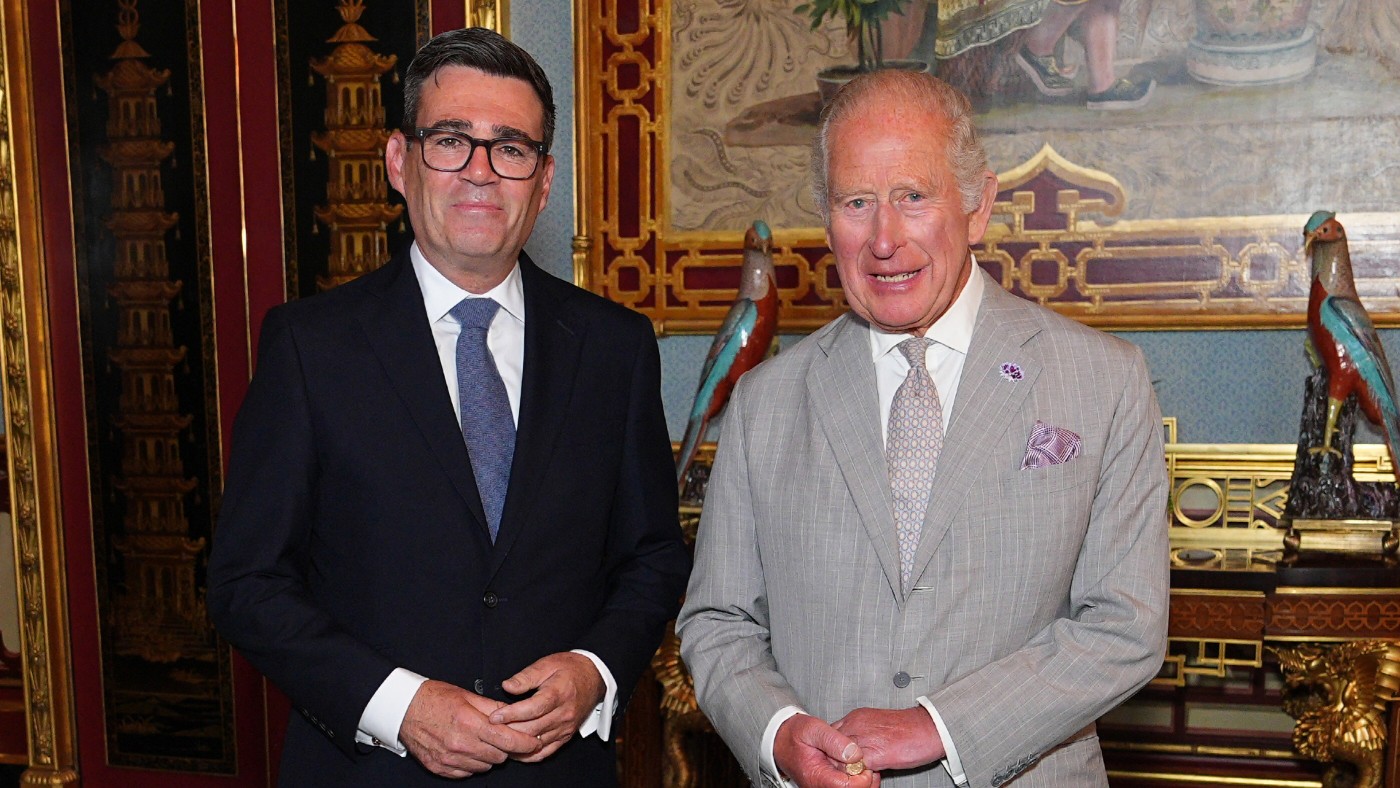
Andy Burnham has taken over from Keir Starmer as prime minister of the UK, promising to deliver a “new political model and a new economic model” for the country.
Speaking to the nation in front of 10 Downing Street on Monday, the former mayor of Manchester said he was “acutely conscious” of the fact that he is the UK’s seventh prime minister since 2016.
“It requires my generation of politicians to raise our game and rise to the new challenge,” Burnham, a minister during the New Labour era of Tony Blair and Gordon Brown, said.
Echoing another former Labour leader, Jeremy Corbyn, Burnham said his first instruction as prime minister would be to “end rough sleeping in our country”.
As mayor of Manchester, Burnham made a similar promise, but after initial success, homelessness in the city has risen since 2021.
New MEE newsletter: Jerusalem Dispatch
Sign up to get the latest insights and analysis on Israel-Palestine, alongside Turkey Unpacked and other MEE newsletters
“Later this year I will bring forward a new plan for Britain, a 10-year plan laying out a path from where we are now to where I believe we all want Britain to be, wherever we’re coming from, whatever party we support,” Burnham said.
“But I can do something to give people some breathing space now, some help with the cost of living. And I will set out some of those measures starting tomorrow, including how we pay for them.”
'Britain took some wrong turns'
The new prime minister did not mention foreign policy, except to say that he would address Britain’s cost of living crisis while still honouring the country’s defence “commitment to international partners”.
A member of Labour Friends of Israel since 2015, Burnham recently called Israel's destruction of Gaza a "scar on our collective conscience", but has not described it as a genocide.
While he has acknowledged that Labour got its approach to Gaza wrong, Burnham is also known to be more interested in domestic politics, a trait his speech demonstrated.
“In the 1980s, Britain took some wrong turns,” Burnham said, as he promised a “new political model and a new economic model”, appearing to outline a break with the neoliberal model brought in by Margaret Thatcher in 1979.
'Political power was centralised, economic power privatised, large parts of the country deindustrialised, and they still haven’t recovered'
- Andy Burnham, UK prime minister
“Political power was centralised, economic power privatised, large parts of the country deindustrialised, and they still haven’t recovered,” Burnham said.
“Many feel as though they’re still in decline, and they don’t have the ability to turn things around.”
Thatcher’s Conservative government privatised an array of sectors in the 1980s, including energy, water and social care, ushering in a neoliberal economic model that was largely accepted by the Labour governments Burnham worked for in the first decade of the 21st century.
Her rewiring of the economy has had – and was intended to have – profound effects, ripping apart the social democratic consensus that had held in Britain from the end of World War Two.
“Economics are the method; the object is to change the heart and soul,” Thatcher said in 1981.
Industries including shipbuilding, coal mining, automotive and textiles were also significantly scaled back, and the new prime minister, who is a noted proponent of moving power away from London and spreading it across the country, spoke of reindustrialising the UK.
Burnham said that he would “build a new economy where we put life’s essentials back under stronger public control to make them affordable to you again”, but stopped short of saying he would nationalise key industries.
The new prime minister promised to build more council homes and to begin announcing “some measures” to address the cost of living crisis on Tuesday.
Starmer bows out
Earlier in the day, in his last speech as prime minister, Keir Starmer once again sketched out the narrative he has settled on in recent weeks.
He took over the Labour Party after the election defeat of 2019 and, he said, changed it “so it was fit to face the country and won a landslide victory in 2024”.
He did not, as he has previously done, falsely claim that Labour under his predecessor Corbyn had been found “institutionally antisemitic”.
Now, after two years in the job, “our public services are on the up”, Starmer said, “children are being lifted out of poverty”, and “immigration is down significantly”.
“It has been the privilege of my life to serve this great country,” Starmer said. He had offered the “brave people of Ukraine” his “unflinching support”.
As Starmer says it now, Burnham’s ascent is a peaceful handover, a transition of power that was almost pre-ordained. “I wish him every success,” Starmer said of Burnham. “He has my full support.”
middleeasteye.net