
Syrians Await Verdicts in Trials of Former Assad Officials
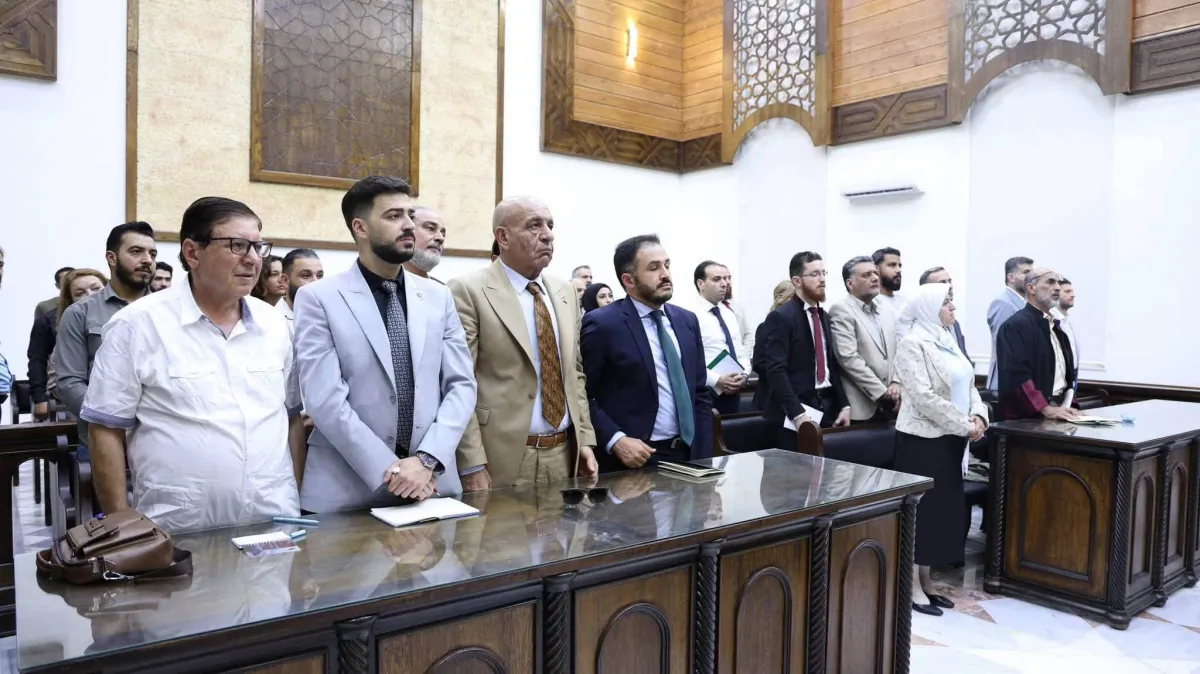
As public hearings gather pace in the trials of former officials from Syria’s ousted regime, families of victims and survivors of torture are anxiously awaiting the verdicts, with many calling for the defendants to receive the death penalty.
Proceedings before the Fourth Criminal Court at Damascus’ Palace of Justice have accelerated since April 25, when the court opened the in-absentia trial of deposed President Bashar al-Assad, his brother Maher al-Assad, and several senior figures from the former regime. Former security chief Atef Najib also appeared before the court in handcuffs.
The court has so far held six hearings for Najib and three for Wassim al-Assad, a cousin of the former president. According to the National Transitional Justice Commission, Wassim al-Assad’s next hearing, scheduled for July 29, is expected to move to deliberations and a verdict.
Three consecutive hearings have also been held for former Grand Mufti Ahmad Hassoun, who is charged with inciting violence and justifying killings during the rule of the former regime.
The trials are being closely followed in the southern province of Daraa, where Najib headed the Political Security branch. In February 2011, his branch arrested more than 20 schoolboys over anti-government graffiti, including the slogan, “It’s your turn, Doctor.” The case, later known as that of the “Children of Freedom,” helped ignite protests in Daraa on March 18, 2011, widely regarded as the start of the Syrian uprising.
Mohammad Abdul Rahman, a Daraa resident whose son died in Saydnaya prison after being arrested at the outset of the uprising, told Asharq Al-Awsat that residents were demanding “the execution of everyone whose hands are stained with the blood of hundreds of thousands of Syrians, not just Atef Najib.”
“There isn’t a single household in Daraa that hasn’t paid a price. Some lost one or more sons to the bullets of the former regime’s army and security services or in its prisons, while those who did not lose loved ones now live amid destruction,” he said. “The people want all of them executed.”
Youssef Sweidan, one of the children arrested in Daraa who remains unable to work because of the severe torture he endured in detention, also called for Najib to be sentenced to death.
“We want Atef Najib executed as a warning to others. Even execution is too lenient given the crimes he committed against the people of Daraa.”
The hearings have been held only days apart. Hassoun’s latest session took place on July 23, with the next set for July 30. Wassim al-Assad appeared on July 22, and prosecutors requested the death penalty, citing evidence and testimony linking him to premeditated murder as well as drug trafficking and distribution. His next hearing is scheduled for July 29. Najib’s latest hearing was held on July 21, with proceedings due to resume on July 28.
Lawyer Noha al-Masri, one of five attorneys serving on a prosecution team representing the plaintiffs in the cases against senior former regime officials, including Najib, dismissed suggestions that the trials were being rushed.
According to al-Masri, the cases reached public hearings only after progressing through the Public Prosecution, the investigating judge, the referral judge, and finally the Criminal Court. Those earlier stages received little public attention, creating the mistaken impression that proceedings had been expedited. In fact, the case against Najib has been underway since February 2025.
Al-Masri said the next hearing in Najib’s case would hear the defense’s arguments, after which the court would decide whether another procedural session was needed or whether the case was ready for deliberation and judgment.
She argued that the prosecution was seeking the death penalty under Syrian law, which provides that the alleged crimes are not subject to a statute of limitations because they were committed while the defendants represented a ruling regime that remained in power until its collapse. By contrast, she noted, international humanitarian law classifies such offenses as crimes against humanity but does not provide for capital punishment, making life imprisonment a possible sentence.
“We cannot prejudge the outcome, but we hope these killers and criminals receive death sentences. We have confidence in our judiciary and its justice.”
Syria’s new authorities have pledged to ensure justice and accountability for atrocities committed under Assad’s rule, while Syrian activists and the international community continue to stress the importance of transitional justice in the war-ravaged country.
aawsat.com