
General Ghalibafs gamble: An IRGC veteran takes on Irans hardliners to pursue diplomacy
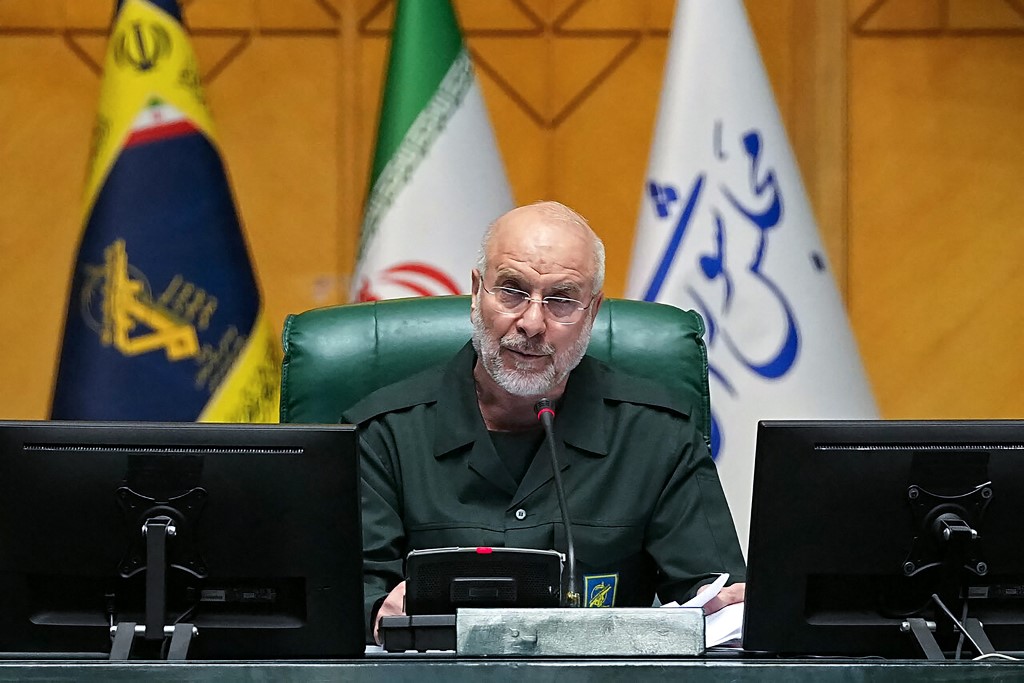
Mohammad Bagher Ghalibaf, Iran's parliament speaker and chief negotiator in talks with the United States, is facing perhaps the greatest political test of his career.
A lifelong conservative and former Revolutionary Guard commander, he is trying to steer the Islamic Republic out of its confrontation with Washington through diplomacy, while fending off fierce attacks from hardliners who accuse him of abandoning Iran's strategic leverage.
A senior political source who spoke to Middle East Eye on condition of anonymity described Ghalibaf as a conservative pragmatist who favours repairing relations with the West while preserving Iran's strategic partnership with China.
"His foreign policy instincts resemble those of [former moderate president] Hassan Rouhani," the source said, "but unlike Rouhani, Ghalibaf is careful not to alienate the Islamic Republic's conservative base."
According to the source, the current supreme leader, Mojtaba Khamenei, shares to some extent that strategic outlook, which has helped cement their alliance.
New MEE newsletter: Jerusalem Dispatch
Sign up to get the latest insights and analysis on Israel-Palestine, alongside Turkey Unpacked and other MEE newsletters
"If they didn't have the same visions and mindset, their alliance wouldn't have lasted this much," the source said, adding that Ghalibaf's relationship with Mojtaba Khamenei has steadily deepened since the early 2000s.
"They gradually became a political team," the source said, pointing to rare public appearances in which the two were photographed sitting beside one another during previous Supreme Leader Ali Khamenei's speeches.
‘[Mohammad Ghalibaf and Mojtaba Khamenei] gradually became a political team’
- A senior political source
According to the source, this partnership has helped Ghalibaf to withstand the growing hardline backlash since the start of the negotiations he is conducting with the US.
"Following the first round of talks with the United States in Islamabad, hardline figures appealed to Mojtaba, accusing Ghalibaf of crossing Iran's red lines," they said.
The effort failed, the source added, with Mojtaba continuing to back Ghalibaf and later appointing him as the Islamic Republic's special representative to China, an appointment that testifies to the considerable support Ghalibaf receives from the new leader.
Pillar of Iran’s security establishment
Ghalibaf's military and political trajectory did not, however, predestine him to attract the wrath of conservatives by attempting to find a diplomatic solution to the war launched by the US and Israel at the end of February.
A veteran of the Iran-Iraq War, Ghalibaf joined the newly established Islamic Revolutionary Guard Corps (IRGC) in his early twenties and fought on the front lines, where he lost his brother. His battlefield record accelerated his rise through the military ranks, and by the 1990s he had held several senior IRGC positions before being appointed commander of the IRGC Air Force.
One defining episode of his military career came during the July 1999 student protests, when security forces violently dispersed demonstrations triggered by the closure of the reformist newspaper Salam. As commander of the IRGC Air Force, Ghalibaf was among 24 senior IRGC commanders who signed a strongly worded letter warning then-President Mohammad Khatami against tolerating further unrest.
Ghalibaf later revealed that he and the late IRGC Quds Force commander Qassem Soleimani drafted the letter and gathered the signatures.
A year later, at just 39, he was appointed chief of Iran's Law Enforcement Forces (Naja), becoming one of the country's youngest senior security officials. He later headed Iran's Anti-Smuggling Headquarters under President Khatami.
During his tenure as police chief, Ghalibaf championed modernisation efforts, including equipping the force with imported vehicles, a move he later described as one of his key achievements.
Ghalibaf subsequently shifted from military to electoral politics, launching three presidential campaigns. He was defeated in 2005 and 2013 and withdrew in favour of Ebrahim Raisi in 2017 to consolidate the conservative vote.
According to a political source who spoke to MEE on condition of anonymity, Ghalibaf had intended to run in the disputed 2009 presidential election but was asked by Supreme Leader Ali Khamenei not to enter the race.
The source said Ghalibaf instead made his campaign infrastructure available to reformist candidate Mir-Hossein Mousavi in his challenge against incumbent Mahmoud Ahmadinejad, who was opposed by other conservatives.
Ghalibaf’s close connection to Soleimani also shaped his political trajectory. According to a conservative source familiar with the relationship, Soleimani privately backed Ghalibaf's 2013 presidential bid.
This was a highly unusual intervention by the late IRGC Quds Force commander, who generally avoided domestic politics. The source said the two men were so close that they lived in the same residential building in Tehran for a period.
Throughout his political career, Ghalibaf has repeatedly reinvented his public image. In his first presidential campaign, he emphasised his academic credentials and experience as a pilot.
In subsequent campaigns, however, he branded himself as a "jihadist manager"- a term in Iranian political discourse that refers to a hands-on, revolutionary-style administrator focused on efficiency and execution.
His military background nevertheless remained central to his public identity. During the 2013 presidential debates, his moderate rival Hassan Rouhani memorably contrasted their approaches by declaring: "I am not a colonel; I am a lawyer," portraying himself as a diplomat rather than a security figure.
After his first presidential defeat in 2005, Ghalibaf was elected mayor of Tehran, serving for 12 years and becoming the longest-serving mayor in the capital's history.
Reformists’ support
Despite his conservative credentials, Ghalibaf has become one of the principal targets of Iran's hardline camp.
According to senior political sources, he frequently clashed with the late conservative President Ebrahim Raisi on major policy issues, while media outlets aligned with Raisi repeatedly attacked him. The influential Paydari (Endurance) Front has also emerged as one of his fiercest critics.
As Iran and the United States moved toward a Memorandum of Understanding (MoU) aimed at ending the war, opposition from hardline factions spilled into the streets. Demonstrators gathered in Tehran and Mashhad to denounce the proposed agreement and accuse Ghalibaf and Foreign Minister Abbas Araghchi of betraying the country.
‘The country needs a deal so it can survive and return to a path of economic development’
- A reformist activist backing Ghalibaf
At a rally in Tehran's Ibn Sina Square, protesters chanted: "Araghchi, have some shame, leave the country alone," and "Ghalibaf, Araghchi, what about the blood of my leader?" Others demanded that both men resign.
Mahmoud Nabavian, deputy chairman of the parliament's National Security and Foreign Policy Committee, publicly read what he claimed was the text of the proposed memorandum and condemned several of its provisions.
The IRGC-affiliated newspaper Javan warned that political disagreements were spilling into the streets, while the conservative Kayhan daily’s editor Hossein Shariatmadari accused Ghalibaf and Araghchi of surrendering one of Iran's most important strategic assets by agreeing not to close the Strait of Hormuz.
Amirhossein Sabeti, a lawmaker closely aligned with the Paydari Front, claimed that Mojtaba Khamenei's views had been ignored during the Islamabad negotiations and rejected what he described as "fake unity".
After hostilities resumed in July, marking the collapse of the MoU signed on 17 June, Sabeti intensified his criticism, writing that Ghalibaf and President Masoud Pezeshkian should either deliver on their promises that negotiations would end the war and lift sanctions or admit that their strategy had failed.
Meanwhile, in an unexpected political shift, reformists who have long been among Ghalibaf's critics have publicly backed his negotiating efforts. Entekhab, a leading reformist outlet, quoted a university professor as saying: "Mr Ghalibaf, move forward. The whole society is behind you. Do not worry about a minority."
A reformist activist who spoke to MEE on condition of anonymity said the decision to support Ghalibaf was driven by a belief that Iran needs to move beyond confrontation and reach an agreement with the US.
"The country needs a deal so it can survive and return to a path of economic development," the activist said.
The campaign against Ghalibaf underscores a remarkable political transformation. Once regarded as one of the Islamic Republic's most prominent security commanders, he now finds himself leading an effort to resolve one of Iran's gravest confrontations through diplomacy - and facing some of the fiercest resistance from within his own conservative camp.
The shift also highlights one of the paradoxes of Ghalibaf's current position: the same figure who once stood on the side of the security establishment during clashes with reformists is now receiving support from that camp because of his efforts to pursue diplomacy with Washington.
middleeasteye.net